Lot 233
British WWI 'Toffee Apple' Trench Mortar Round
פתיחה: $250
British WWI 'Toffee Apple' Trench Mortar Round
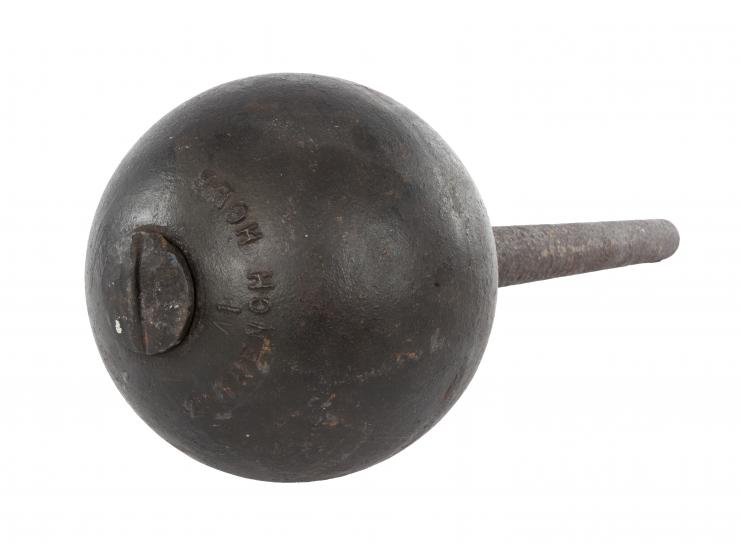
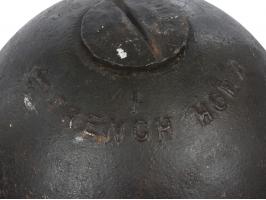
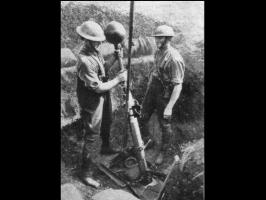
This is the infamous 'Toffee Apple' or 'Plum Pudding' mortar bomb, one of the iconic weapons of c.1915-1916 trench warfare. Inert 9" diameter round steel warhead is complete with the launching rod. Top of the warhead has raised embossed inscription " 2" TRENCH HOW'R". The launching rod is attached with a glaringly bright, modern screw (easily sorted by digging through those dusty mason jars of old fittings you have been saving in the garage for just such an opportunity!). These were originally equipped with a standard artillery fuze, and later with threaded housing for an impact fuze which improved the bomb's effectiveness when used to clear barbed wire entanglements in preparation for an assault. This example has the soft metal shipping / fill plug in place. They were dispatched to the front lines with the projectile, fuzes, propellant, and launching rod as separate components, to be assembled just prior to use.
Numerous WWI personal accounts mention these projectiles specifically, especially those written by the troops on the receiving end who despised them. Ernst Jünger called them "...personally malignant. They're insidious beasts." in his classic account of WWI trench warfare Storm of Steel. In his 1931 work Up to Mametz and Beyond, Captain Llewelyn Wyn Griffith of the 15th Royal Welch Fusiliers describes a barrage of 2-inch mortars: "A pop, and then a black ball went soaring up, spinning round as it went through the air slowly; more pops and more queer birds against the sky. A stutter of terrific detonations seems to shake the air and the ground, sandbags and bits of timber sailed up slowly and then fell in a calm deliberate way. In the silence that followed the explosions, an angry voice called out in English across No Man’s Land, ‘YOU BLOODY WELSH MURDERERS.’" They were not much liked by either side, as it turns out.
The artillery-fuzed mortar bomb produced numerous complaints when it was discovered that it burrowed into the soft mud and then exploded, creating a huge crater which was filled with the barbed wire entanglement that had been previously on the surface. This created a much more formidable obstacle for the advancing infantry than what was there before. One reference notes a few further features that annoyed those on the sending part of the equation: the shorter-range shots were dangerous due to a tendency to fall short, it was imprecise, and often the explosion sent the rather heavy and thus kinetically deadly launching rod sailing back toward the trench from whence it came. All of these complaints led to its replacement in 1917 by the Newton 6-in Medium Mortar.
As Advance Guard Militaria we had a few of these that came to us in the purchase of the Oorlogsmuseum Dadizele back in 1999 / 2000, but since that time I could count on one hand the number that that I have observed in collections or at shows here in the US. An iconic and very interesting artifact from the war in the trenches!
$500 - $700